
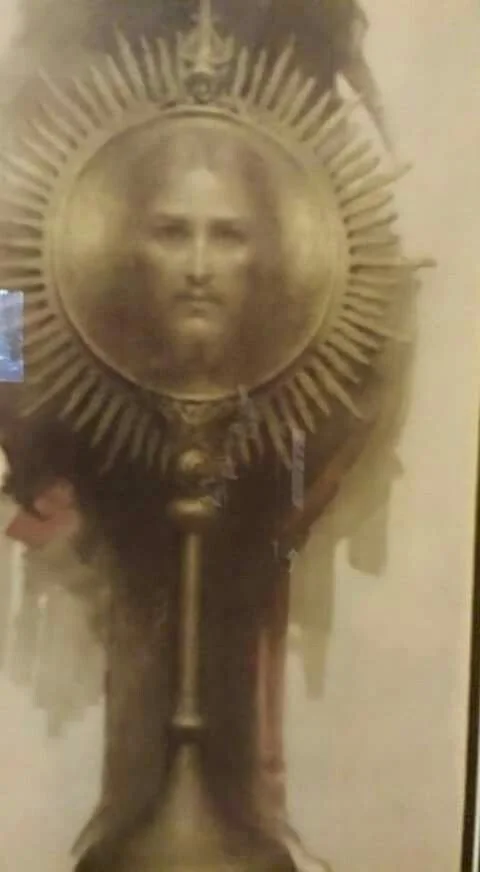
Reverence for the Holy Eucharist.
At the very heart of the Catholic faith is the Holy Eucharist. It is not a symbol or a representation, but truly and substantially Our Lord Jesus Christ: His Body, His Blood, His Soul, and His Divinity. Every Host, even the smallest fragment, contains the whole Christ. Because of this, the Church has always called the faithful to approach the Holy Eucharist with the deepest reverence, humility, and awe.
What Reverence Truly Means
Reverence is not a human invention. It is revealed by God Himself. In Sacred Scripture, reverence means recognising the holiness of God and responding with awe, humility, obedience, and a holy fear of offending Him.
The Bible shows clearly that what is consecrated to God must never be treated as ordinary.
One of the most striking examples is found in the Old Testament with the Ark of the Covenant, the sacred dwelling place of God’s presence among His people.
When the Ark was being transported, an incident occurred:
“And when they came to the threshing floor of Nacon, Uzzah put forth his hand to the ark of God and took hold of it, for the oxen shook it. And the anger of the Lord was kindled against Uzzah, and God struck him there for his error; and there he died beside the ark of God.”
(2 Samuel 6:6-7)
Uzzah’s action may have appeared well-intentioned. He reached out to steady the Ark. Yet God had already given clear instructions regarding what was consecrated:
“They shall not touch any holy thing, lest they die.”
(Numbers 4:15)
This reveals something essential:
Holiness is not defined by intention alone.
What is consecrated to God must be approached according to His order.
God’s presence is not to be treated casually.
The Ark of the Covenant was a shadow of something far greater.
The Ark contained the tablets of the Law, the manna from heaven, and the rod of Aaron, which were signs of God’s covenant.
But the Holy Eucharist is not a sign.
It is Jesus Christ Himself.
If such reverence was required for the Ark, which held sacred signs, how much more for the Eucharist, which is God truly present?
This account is not simply an isolated moment. It reveals a lasting principle.
God teaches His people how what is holy is to be approached.
This principle does not disappear with the coming of Christ. It deepens.
Within the life of the Church, this reverence is expressed through sacred order.
Sacred Ministers and the Consecrated Hands of the Priest
The ordinary ministers of Holy Communion are:
the Bishop, the Priest, and the Deacon.
They are sacred ministers who have received the Sacrament of Holy Orders.
Within this sacred order, however, the hands of the priest have a particularly profound relationship with the Holy Eucharist.
In the traditional rite of priestly ordination, the bishop solemnly anoints the hands of the newly ordained priest with sacred chrism. This beautiful rite visibly expresses that these hands have been set apart for sacred service and, in a particular way, for the priest's ministry at the altar.
The priest's hands will take bread and wine and offer the Holy Sacrifice. Through the priest acting in persona Christi, Christ Himself acts sacramentally, and at the words of Consecration the bread and wine become the Body and Blood of Our Lord Jesus Christ.
These hands elevate the Sacred Host.
These hands hold the chalice containing the Precious Blood.
These hands break the consecrated Host.
These hands give the Body of Christ to the faithful.
The significance of the priest's hands therefore should not be dismissed as an insignificant ceremonial detail. Their consecration expresses something profound about the Catholic priesthood and its intimate relationship with the Holy Eucharist.
This helps us understand why, throughout the Church's tradition, such extraordinary care developed around who handled the Sacred Species.
The Eucharist was never regarded as ordinary bread to be casually passed from one person to another.
It is the Body of Christ.
The Church's present discipline does not teach that only the anointed hands of a priest may ever touch the Sacred Host. Deacons are ordained sacred ministers and ordinary ministers of Holy Communion, and the Church also permits properly deputed lay faithful to serve as Extraordinary Ministers of Holy Communion when genuine necessity calls for their assistance.
But these exceptions do not erase the profound Eucharistic significance of the priest's consecrated hands.
Nor do they erase the distinction between ordinary sacred ministry and extraordinary lay assistance.
Indeed, the Church teaches in Redemptionis Sacramentum that recourse to Extraordinary Ministers of Holy Communion is to occur “only out of true necessity”, and that their function is supplementary and provisional.
Therefore, wherever sufficient sacred ministers are available to distribute Holy Communion, the Church's own order should be respected.
This is not because the hands of lay Catholics are somehow dirty or because laypeople possess less human dignity. Nor is it a judgment upon the devotion of those who serve as Extraordinary Ministers.
It is because the Holy Eucharist is not ordinary, and the Church herself has established a sacred order surrounding its celebration and distribution.
The priest's consecrated hands are a particularly beautiful sign of this reality.
They remind us that what takes place upon the altar is not an ordinary meal.
The priest is not simply presiding over a gathering.
The Sacred Host is not ordinary bread.
And Holy Communion is not something casually passed from hand to hand.
Before us is Jesus Christ Himself: Body, Blood, Soul, and Divinity.
For this reason, the traditional practice of receiving Holy Communion directly upon the tongue also carries a profound symbolism: the communicant does not take the Sacred Host into his or her own hands but receives Our Lord from the Church.
When accompanied by kneeling, the body itself professes:
I do not take Him. I receive Him.
I do not approach ordinary food. I approach God.
These are not mere appearances of bread to be handled casually. This is Jesus Christ.
The consecrated hands of the priest, the careful handling of the Sacred Species, reception rather than self-communication, and kneeling before Our Lord all point toward the same central truth:
The Eucharist is sacred because the Eucharist is Jesus.
Reverence in the Presence of God
Throughout Sacred Scripture, reverence before God is expressed in very real and visible ways.
It includes a holy fear of the Lord:
“Serve the Lord with fear, and rejoice with trembling.”
— Psalm 2:11
It includes bodily humility:
“O come, let us worship and bow down; let us kneel before the Lord our Maker.”
— Psalm 95:6
It includes recognising holy ground:
“Take off your sandals from your feet, for the place on which you are standing is holy ground.”
— Exodus 3:5
Reverence, therefore, is not merely external behaviour. It is the response of the whole person, body and soul, to the reality of God.
And this has profound significance for how we behave inside a Catholic church.
Jesus Is Truly Present in the Tabernacle
A Catholic church is not simply a building in which Christians happen to gather once a week.
Wherever the Blessed Sacrament is reserved within the tabernacle, Jesus Christ is truly present.
The same Jesus whom we receive at Holy Communion remains sacramentally present under the Eucharistic species reserved within the tabernacle.
The tabernacle is therefore not merely a symbolic reminder of Christ.
He is there.
This changes the meaning of the entire sacred space.
When we enter a Catholic church in which the Blessed Sacrament is reserved, we are entering the presence of the King.
We may not see Him with our eyes.
We may not feel anything extraordinary.
The church may appear quiet and empty.
But faith tells us that it is not empty.
Jesus Christ is there.
The sanctuary lamp burning near the tabernacle is itself a visible reminder of this extraordinary reality: Our Lord is present.
A Catholic Church Should Never Feel Ordinary
Because of the Real Presence, a Catholic church should never be treated in exactly the same manner as an ordinary hall, meeting room, theatre, community centre, café, or social gathering place.
There may be friendship and community within parish life, and Catholics should certainly welcome one another with charity and warmth.
But the church itself has a sacred purpose.
Before it is a place where we encounter one another, it is a place where we encounter Him.
This distinction matters.
If ordinary conversation, unnecessary noise, socialising, casual behaviour, food and drink, constant movement, or other distractions become normal within the sacred space, it can become increasingly difficult to recognise through our outward behaviour that Someone extraordinary is present.
The danger is not merely that a particular rule of etiquette might be broken.
The deeper danger is that the sacred gradually begins to feel ordinary.
And Jesus Christ in the tabernacle must never become ordinary to us.
Our Behaviour Should Reveal Who Is Present
Imagine entering a room knowing that Jesus Christ stood visibly before you.
Would you behave exactly as you would in an ordinary room?
Would you continue an unnecessary conversation without acknowledging Him?
Would you pass before Him without any sign of reverence?
Would you allow noise and distraction to occupy your attention while the Lord waited before you?
The Eucharistic Presence asks faith to recognise what the eyes cannot see.
This is precisely why outward acts of reverence matter.
We genuflect toward the tabernacle because Someone is there.
We kneel in prayer because Someone is there.
We lower our voices because Someone is there.
We preserve sacred silence because Someone is there.
We teach our children reverence because Someone is there.
We refrain from treating the church as an ordinary social space because Someone is there.
And that Someone is Jesus Christ.
These actions are not meaningless traditions or empty formalities. They are bodily professions of faith in the Real Presence.
Every genuflection says:
“I believe You are here.”
Every moment of prayerful silence says:
“You are worthy of my attention.”
Every act of reverence says:
“This place is different because You are here.”
Silence Is Not Emptiness
Sacred silence is particularly important.
Silence within a Catholic church is not awkward emptiness that needs to be filled.
It creates space for prayer, recollection, adoration, and awareness of God.
Someone kneeling quietly several pews away may be grieving.
Someone may be discerning a vocation.
Someone may be pleading for the conversion of a loved one.
Someone may have just received devastating news.
Someone may simply be trying to listen to God.
And someone may have come into the church for no other reason than to sit silently before Jesus in the tabernacle.
Our behaviour should help protect that encounter rather than interrupt it unnecessarily.
A Catholic church should be one of the increasingly rare places in our noisy world where a soul can enter, become still, and encounter silence before God.
“Be still, and know that I am God.”
— Psalm 46:10
This Applies to Every Form of the Mass
Reverence does not belong exclusively to the Traditional Latin Mass.
Nor should silence, genuflection, kneeling, sacred music, recollection, or profound devotion to the Blessed Sacrament ever be regarded as belonging only to Catholics who prefer older liturgical traditions.
They belong to the Catholic faith itself.
Jesus Christ is no less present because Mass is celebrated according to the ordinary form of the Roman Rite.
The tabernacle does not contain a different Jesus in a Novus Ordo parish.
It is the same Lord.
Therefore, a Novus Ordo Catholic church should also unmistakably communicate through its atmosphere, worship, silence, gestures, and treatment of the sanctuary that Jesus Christ is truly present.
Sadly, Catholics can sometimes encounter parish churches where unnecessary conversation, casual socialising, noise, movement, or an atmosphere resembling an ordinary gathering has become commonplace, including before or after Mass.
This should not be treated as an inevitable characteristic of the Novus Ordo itself.
Many ordinary-form parishes celebrate the sacred liturgy with profound reverence.
The deeper problem arises whenever Catholics, regardless of the form of Mass, begin to lose awareness of Who is present.
The answer is therefore not simply to prefer one liturgical community over another.
The answer is to restore Eucharistic faith and reverence wherever they have weakened.
Fellowship Has Its Proper Place
Catholic community and fellowship are good things.
Parishioners should know one another, welcome newcomers, support families, care for the lonely, and enjoy one another's company.
But there is a proper place for everything.
Conversation and fellowship can flourish outside the church, in the parish hall, courtyard, gathering space, or another appropriate area.
The sacred space surrounding the tabernacle should remain principally a place of worship, prayer, recollection, and encounter with God.
This is particularly important immediately before and after Mass.
Before Mass, silence allows the faithful to prepare their hearts for the Holy Sacrifice.
After Mass, it allows those who have just received Jesus Christ in Holy Communion to remain with Him in thanksgiving and prayer.
We should be careful that our desire to speak with one another does not unintentionally deprive another person of the silence in which they are trying to speak with God.
Teaching Our Children That God Is Here
This reverence should also be lovingly taught to children.
Children naturally learn through what they see.
If they see adults genuflect toward the tabernacle, lower their voices, kneel in prayer, make thanksgiving after Communion, and behave differently inside the church than they do outside it, they gradually learn something profound:
This place is different.
Jesus is here.
Children will naturally make noise at times, particularly very young children, and families should never be made to feel unwelcome because of this. The ordinary sounds of babies and children are very different from unnecessary adult conversation or deliberate casualness.
What matters is that children are gradually formed in reverence according to their age and ability.
One of the greatest gifts we can give them is the understanding that when they enter a Catholic church and see the sanctuary lamp burning beside the tabernacle, they are entering the presence of Jesus Christ Himself.
Holy Ground
When Moses approached the burning bush, God told him:
“Take off your sandals from your feet, for the place on which you are standing is holy ground.”
— Exodus 3:5
A Catholic church containing the Blessed Sacrament is sacred not because the bricks, timber, stone, stained glass, statues, or architecture possess holiness by themselves.
Its deepest treasure is Who dwells there sacramentally.
Behind the tabernacle door, beneath the humble appearance of bread, is the same Jesus who was born in Bethlehem, walked the roads of Galilee, healed the sick, forgave sinners, suffered upon the Cross, rose from the dead, and ascended into Heaven.
He is there.
If we truly believe this, then reverence is not excessive.
Silence is not excessive.
Genuflection is not excessive.
Kneeling is not excessive.
Adoration is not excessive.
They are natural responses to an extraordinary reality:
God has chosen to dwell among us.
A Catholic church should therefore never become merely ordinary in our eyes.
The world has many places for conversation, entertainment, meetings, noise, and social activity.
But within the Catholic church, before the tabernacle, we are given something the world cannot give:
the sacramental Presence of Jesus Christ.
And when we remember Who is there, our behaviour naturally begins to change.
Reverence is ultimately the outward expression of an inward conviction:
I know Who is before me.
I believe He is here.
And because He is here, this place is holy.
A New Testament Warning
This same seriousness continues in the New Testament.
Saint Paul gives a direct warning regarding the Eucharist:
“Whoever, therefore, eats the bread or drinks the cup of the Lord in an unworthy manner will be guilty of profaning the body and blood of the Lord.”
(1 Corinthians 11:27)
This confirms that the Eucharist must never be approached casually or treated as ordinary food. To do so is not simply a mistake. It is a profanation of the Body and Blood of Christ.
How the Earliest Christians Received the Holy Eucharist
From the earliest centuries, Christians approached the Eucharist with profound awareness of the sacred. The Church Fathers speak of great care being taken to ensure that no fragment of the Sacred Host was lost. While external practices varied across regions and periods, the constant reality remained: the Eucharist was treated as holy beyond all comparison.
As the Church’s understanding and liturgical expression developed over time, practices became more visibly protective of this mystery. Reception on the tongue and the use of consecrated hands became the universal norm in the Latin Church for many centuries. This was not a rejection of earlier times. It was a deepening of reverence and a clearer expression of what the Church has always believed: we are receiving God Himself.
The Use of Extraordinary Ministers of Holy Communion
In more recent times, the use of laypeople to assist with the distribution of Holy Communion has become widespread in many Catholic parishes.
It is important, however, to understand what the Church actually teaches about this ministry.
The Church does not describe the layperson who assists with distributing Holy Communion simply as another ordinary minister alongside the priest and deacon.
The proper title is:
Extraordinary Minister of Holy Communion.
The word extraordinary matters.
The Church's instruction Redemptionis Sacramentum, issued in 2004 by the Congregation for Divine Worship and the Discipline of the Sacraments by mandate of Pope St John Paul II, gives particularly clear instructions concerning this ministry.
Ordinary and Extraordinary Are Not the Same
Redemptionis Sacramentum §154 explains that, by reason of Sacred Ordination, the ordinary ministers of Holy Communion are the Bishop, Priest, and Deacon.
It says that it belongs to these sacred ministers to administer Holy Communion to the lay faithful during Mass.
The document even explains why this distinction has importance: through it, the ministerial office of the ordained is properly manifested and the “sign value of the Sacrament is made complete.”
This means that the distinction between ordinary and extraordinary ministers is not meaningless terminology.
It expresses the sacred order of the Church.
A layperson may indeed be authorized to assist with the distribution of Holy Communion, but that person does not thereby become an ordinary minister of Holy Communion.
The ministry remains extraordinary.
“Only Out of True Necessity”
Redemptionis Sacramentum §151 uses particularly strong language:
“Only out of true necessity is there to be recourse to the assistance of extraordinary ministers in the celebration of the Liturgy.”
The same paragraph then makes another extremely important clarification.
This assistance is not intended simply to provide greater participation for laypeople.
Instead, the Church describes the function as:
“supplementary and provisional.”
These words deserve serious consideration.
True necessity.
Supplementary.
Provisional.
This is very different from treating the distribution of Holy Communion by laypeople as simply another routine liturgical role that should occur at every Mass regardless of circumstances.
The Church permits extraordinary ministers because circumstances can genuinely arise in which their assistance is needed.
But the exception should not obscure the ordinary order established by the Church.
What If There Are Enough Priests or Deacons?
Redemptionis Sacramentum §157 is even more explicit.
It states that if a sufficient number of sacred ministers is normally present for the distribution of Holy Communion, Extraordinary Ministers of Holy Communion may not be appointed to perform this function.
And if laypeople have already been appointed as Extraordinary Ministers, the instruction states that under those circumstances they should not exercise the ministry.
The document goes further still.
It specifically reproves the practice of priests who are present at Mass but refrain from distributing Holy Communion and instead turn the function over to laypeople.
This is an important point because it demonstrates that the Church does not consider the identity of the person distributing the Holy Eucharist to be completely irrelevant.
There is an ordinary sacred ministry established by the Church, and extraordinary lay assistance exists to supplement it when genuine circumstances require assistance.
What Actually Counts as Necessity?
Redemptionis Sacramentum §158 tells us.
An Extraordinary Minister of Holy Communion may administer Communion:
when the Priest and Deacon are lacking;
when the Priest is prevented by weakness, advanced age, or another genuine reason;
or
when the number of faithful approaching Holy Communion is so great that the celebration of Mass would otherwise be unduly prolonged.
But the Church immediately places an important qualification upon that final reason.
A brief prolongation of the Mass is not sufficient justification.
That is significant.
The Church does not say that an Extraordinary Minister should be used merely because Communion would take a little longer without one.
It does not establish a particular number of communicants at which lay ministers automatically become necessary.
The question is whether the circumstances amount to genuine necessity and whether Communion would otherwise cause the celebration to be unduly prolonged, taking the circumstances into account.
Therefore, convenience and genuine necessity should not be confused.
Extraordinary Should Not Quietly Become Ordinary
This is particularly important in parishes where Extraordinary Ministers of Holy Communion have become an automatic feature of virtually every Mass.
A practice can become familiar without necessarily reflecting what the Church's instruction actually envisions.
If there is a priest and only a relatively small congregation, for example, the mere fact that distributing Communion alone would take several additional minutes does not itself satisfy the standard described in Redemptionis Sacramentum.
The document expressly tells us that a brief prolongation is insufficient.
This should cause us to reflect seriously upon situations in which Extraordinary Ministers are used habitually even though sufficient sacred ministers are present or there is no genuine necessity.
The Church did not call this ministry “extraordinary” accidentally.
Nor should we quietly redefine extraordinary to mean ordinary simply because a practice has become familiar.
Why Does This Matter?
This is not merely about rules.
The rules themselves protect and communicate theological realities.
The Holy Eucharist is not ordinary bread.
Its distribution is not an ordinary task.
The priesthood is not simply one ministry among interchangeable ministries.
And the distinction between the ordained priesthood and the common priesthood of the faithful is not something the Church wishes to blur.
Redemptionis Sacramentum itself warns that liturgical abuses can contribute to the “obscuring of the Catholic faith and doctrine” concerning the Eucharist.
This is precisely why outward practices matter.
When almost everyone can appear to approach the altar, handle the Sacred Host, and distribute Holy Communion as though this were simply another parish role, the visible distinction surrounding the Eucharist can gradually become less apparent.
That does not mean an authorized Extraordinary Minister is doing something inherently irreverent.
It means that the Church herself wants the distinction between ordinary sacred ministry and extraordinary lay assistance to remain visible.
The Eucharist Should Never Become Commonplace
There is also a deeper spiritual concern.
Familiarity can gradually produce casualness.
When the Sacred Host is routinely handled by numerous people, passed from minister to communicant, received into hands, and approached with little outward distinction from ordinary eating, we should at least ask whether our external practices are helping Catholics comprehend the extraordinary reality before them:
This is Jesus Christ.
This is precisely where Eucharistic discipline and Eucharistic reverence meet.
The Church's norms are not arbitrary obstacles.
They remind us that the Eucharist belongs to an entirely different order from ordinary food.
The distribution of the Body of Christ should therefore never be reduced to questions of efficiency:
How can we make the Communion line move faster?
How can we save a few minutes?
The more important question is:
How should we treat Jesus Christ?
If Communion takes several minutes longer because the priest himself is distributing the Body of Christ, those minutes need not be regarded as wasted time.
They can be moments of prayer.
They can be moments of preparation.
They can be moments of thanksgiving.
They can remind us that receiving Holy Communion is not something to be hurried through.
This Is Not an Attack Upon Extraordinary Ministers
None of this should be interpreted as a condemnation of individual Catholics who serve as Extraordinary Ministers of Holy Communion.
Many serve generously, reverently, and in obedience to their pastors.
And where genuine necessity exists, the Church herself permits and provides for their assistance.
The issue is therefore not:
“Is this layperson a good enough Catholic to touch the Eucharist?”
That is not the Church's criterion.
The proper question is:
“Is extraordinary assistance actually necessary in these circumstances?”
That is much closer to the question Redemptionis Sacramentum asks.
The concern is not about elevating one Catholic above another.
It is about preserving the sacred order established by the Church and allowing that order itself to teach us something about the extraordinary holiness of the Eucharist.
The Church Herself Calls for Correction Where Necessary
Redemptionis Sacramentum §160 asks diocesan bishops to reconsider the practice regarding Extraordinary Ministers and, where circumstances require it, to correct it or define it more precisely.
This demonstrates that the Church herself recognized the possibility that this extraordinary ministry could become improperly widespread or insufficiently regulated.
And the instruction concludes with an even broader principle.
In §183, Catholics are urged to do everything within their power to ensure that the Most Holy Eucharist is protected from “any and every irreverence or distortion” and that abuses are corrected.
That is the heart of the matter.
This should not be motivated by hostility.
It should be motivated by love.
Love for the priesthood.
Love for the Church's sacred order.
Love for the Holy Eucharist.
And above all:
love for Jesus Christ truly present within It.
Extraordinary Ministers of Holy Communion have a legitimate place when the Church's conditions call for their assistance.
But extraordinary ministry should remain extraordinary.
Where the priest or other sacred ministers are able to distribute Holy Communion without the Mass being unduly prolonged, there is something profoundly fitting about allowing the sacred ministers themselves to place the Body of Christ into the mouths of the faithful.
The Eucharist does not need to be hurried.
Jesus does not need to be made more efficient.
He needs to be adored.
Lex Orandi, Lex Credendi
The Church has long expressed a profound truth in the phrase:
Lex orandi, lex credendi
“The law of prayer is the law of belief.”
This means that how we worship shapes what we believe.
If the Holy Eucharist is treated casually, belief in the Real Presence can gradually weaken. If it is approached with reverence, silence, and adoration, faith is strengthened and preserved.
The way we receive Holy Communion is therefore not insignificant. It is a reflection of what we believe about who is truly present before us.
Receiving the Holy Eucharist with Reverence
Because Jesus Christ is fully present in the Eucharist, even in the smallest fragment, the manner in which we receive Him matters deeply.
Receiving Holy Communion kneeling and on the tongue expresses humility, adoration, and trust. It makes visible what is invisible:
That we receive, rather than take, the gift of God.
That we approach Our Lord in humility.
That we recognise His Real Presence.
That we seek to protect even the smallest fragment of the Sacred Host.
When receiving on the tongue, the risk of particles being lost is reduced. This is not merely a matter of preference. It is about safeguarding the Eucharistic Presence.
To kneel is to adore. Throughout Scripture, kneeling is the posture of those who recognise the presence of God. In the Holy Eucharist, we are not before a symbol. We are before Him.
The Importance of Kneelers
Kneelers serve both a practical and spiritual purpose. They assist the faithful, especially the elderly, the weak, or those with physical limitations, in receiving Holy Communion in a stable and reverent posture.
Their presence communicates that kneeling is welcomed and supported. Without them, many may feel unable or discouraged from receiving in this way.
Providing kneelers is a simple yet meaningful step toward restoring reverence within the Church.
Reverence in Every Mass
The call to reverence before the Holy Eucharist is not limited to one particular form of the Mass, but belongs to every Catholic heart before Jesus Christ truly present in the Blessed Sacrament. Whether at the Traditional Latin Mass or the Novus Ordo Mass, the faithful are called to remember before whom they stand.
While many Novus Ordo Masses are celebrated with deep reverence and fidelity, in many places sacred silence, recollection, and outward reverence have gradually diminished. Yet the Church continually calls the faithful back to deeper awareness of the holiness and majesty of God truly present among us.
“Be still, and know that I am God.” — Psalm 46:10
“The Lord is in His holy temple; let all the earth keep silence before Him.” — Habakkuk 2:20
“At the name of Jesus every knee should bow.” — Philippians 2:10
At every Mass, Heaven touches earth. The Holy Sacrifice of Calvary is made present upon the altar, and Jesus Christ becomes truly present within the Holy Eucharist. Because of this, sacred silence, kneeling, genuflection, prayerful recollection, and reverent devotion are not empty externals, but visible expressions of faith in the living God before us.
The Church has long understood this truth through the principle of lex orandi, lex credendi — “the law of prayer is the law of belief.” The way we worship shapes what we believe, and what we believe shapes the way we worship.
When reverence is strengthened, faith in the Real Presence is strengthened also. Through silence, humility, Eucharistic adoration, and loving devotion before Our Lord, souls are drawn away from worldly distraction and lifted toward deeper awareness of Jesus Christ truly present within His Church.
Sacred Silence and Sacred Music
Throughout the history of the Church, sacred music and sacred silence have helped lift the soul toward God and draw the heart into prayer, recollection, and contemplation before the sacred mysteries.
The purpose of music within the Mass is not entertainment or performance, but worship. Sacred music should assist the faithful in turning their hearts toward Jesus Christ, fostering reverence, prayer, and awareness of the holiness of the Holy Eucharist.
Sacred silence is equally important. Moments of silence before Mass, during the liturgy, and especially after receiving Holy Communion allow the soul to recollect itself before the living God truly present within us.
In an increasingly noisy and distracted world, silence within sacred spaces becomes a profound witness to the Presence of God. The Church continually calls the faithful not to conform themselves to the spirit of the world, but to be transformed in Christ. Reverence within the liturgy should therefore help lift the soul beyond worldly distraction and toward the beauty, holiness, and transcendence of God.
We are all called to holiness and sainthood in Jesus Christ. Sacred silence, reverent worship, and music ordered toward prayer help lift the soul toward Heaven, drawing hearts away from worldly distraction and forming within us deeper recollection, reverence, and likeness to Christ.
When sacred music, prayerful silence, reverence, and recollection are preserved within the Mass, the heart is more easily drawn into deeper awareness of Jesus Christ truly present within the Holy Eucharist.
A Call to Restore Reverence
Reverence for the Holy Eucharist is not about rigid externalism or legalism. It is about love, love for Jesus Christ truly present among us.
To receive Him with care, to protect even the smallest fragment, and to approach Him on our knees in humility are acts of faith.
In a world that has grown increasingly casual toward the sacred, we are called to respond with reverence.
Through small but intentional acts, we help restore what must never be forgotten:
That the Holy Eucharist is not a thing.
It is not a symbol.
It is a Person.
He is truly here.
It is Jesus Christ, Body, Blood, Soul, and Divinity.
It is God.